September 29, 2026
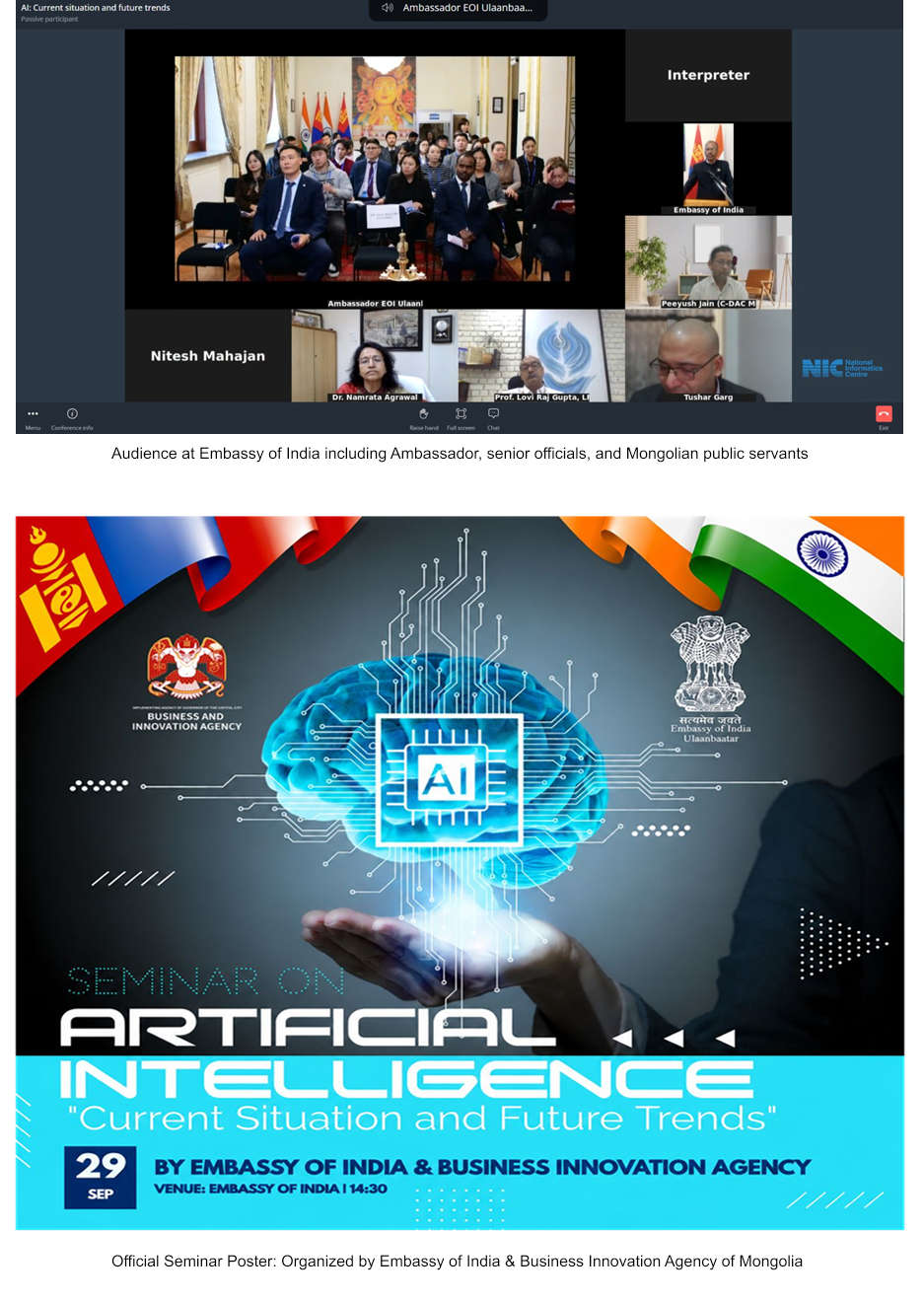
In a step towards strengthening India-Mongolia technological cooperation, the Embassy of India in Ulaanbaatar, in collaboration with the Business Innovation Agency of Ulaanbaatar Municipality, organised a capacity-building seminar titled “Artificial Intelligence: Current Situation and Future Trends” on September 29th, 2026.
Conducted in hybrid mode with simultaneous interpretation into Mongolian, the seminar brought together Mongolian public servants, technology professionals and government officials to explore the evolving landscape of artificial intelligence and its practical applications in public administration. The initiative underscored the commitment of both nations to strengthening technological collaboration and advancing Mongolia’s digital transformation agenda.
H.E. Mr. Atul Malhari Gotsurve, Ambassador of India to Mongolia, inaugurated the seminar with opening remarks emphasizing India's commitment to technological cooperation with Mongolia.Head of the Business Innovation Agency of Ulaanbaatar Municipality, delivered remarks highlighting Mongolia's strategic interest in AI-driven transformation of public services and entrepreneurship ecosystem. The seminar featured distinguished experts from India's leading institutions, each addressing specific dimensions of AI technology, applications, and future opportunities.
Shri Peeyush Jain, Scientist-E at the C-DAC, Mohali, delivered the expert session on "Current Global Developments in Artificial Intelligence and Recent Advances in AI Technologies and Applications" with an explicit focus on public sector applications representing India's advanced computing research community.
The session addressed critical infrastructure resilience, particularly smart grids and power systems management, directly relevant to Mongolia's energy modernization priorities. AI-augmented anomaly detection enabling real-time response to grid disturbances, predictive maintenance reducing infrastructure downtime, and AI-powered demand forecasting optimizing resource allocation: all applications applicable to Mongolia's public administration and energy sector were discussed.
The session also addressed AI applications in public security and governance, including deepfake detection and information integrity. Healthcare and finance applications were framed through the lens of government service delivery and public policy. Crucially, Shri Jain emphasized the limitations, risks, and importance of responsible AI, a balanced perspective essential for public sector adoption. He highlighted that domain expertise combined with AI creates optimal value, positioning government officials as essential partners in responsible AI deployment rather than passive recipients of technology.
The seminar attracted significant attendance from Mongolia's public administration community. Participants included officials from Mongolia's Ministry of Digital Development, Energy & Transport; the National University of Mongolia; and various government agencies. The enthusiastic participation reflected genuine interest in understanding how AI can support Mongolia's governance modernization while maintaining public trust and safety. Mongolian interpretation ensured full accessibility, removing language barriers to understanding cutting-edge technology. This commitment to inclusive, accessible knowledge-sharing exemplified the Embassy's diplomatic and educational mission.
The seminar represented a significant step in India-Mongolia bilateral technological cooperation. Officials from the Embassy of India emphasized that India's leadership in AI research and its commitment to sharing knowledge with neighbouring nations strengthen regional technological ecosystems. The capacity-building approachfocused on practical knowledge transfer and responsible AI deploymentaligns with both nations' development objectives. Mongolia's Business and Innovation Agency recognized the seminar as a valuable contribution to building Mongolia's AI competency in the public sector, positioning government officials as informed stakeholders in AI governance and deployment decisions.
The capacity-building seminar on "Artificial Intelligence: Current Situation and Future Trends" delivered at the Embassy of India, Ulaanbaatar, on September 29th, 2026, represented more than a single knowledge-transfer event, it symbolized both nations' commitment to responsible AI development, public sector modernization, and deepening technological cooperation.