Hyderabad
October 7, 2026
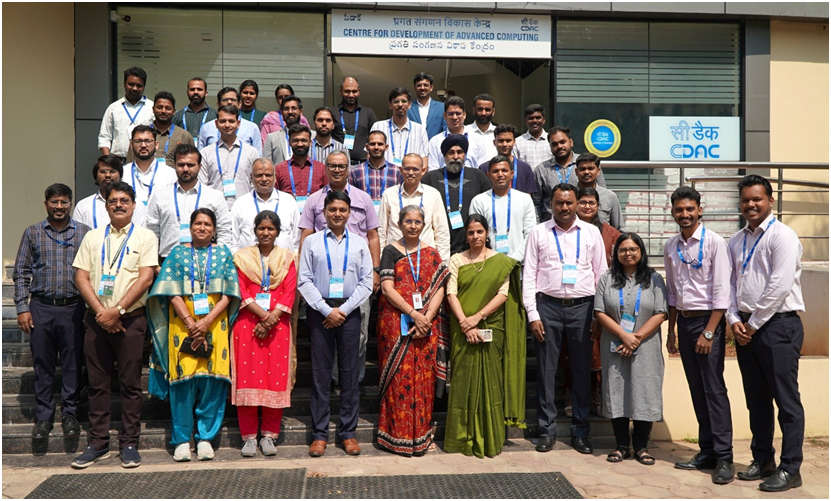
C-DAC, Hyderabad, successfully conducted a three-day training programme on "Security Audit of AI Systems" from October 5th to 7th, 2026, aimed at strengthening capabilities in vulnerability assessment of AI-based web applications and systems. The programme was designed for internal security testing and auditing teams from various government and critical-sector organisations.
Dr. P. R. Lakshmi Eswari, Scientist G, addressed the participants and emphasised the growing need for security audits of AI systems, given their increasing adoption across organisations. She highlighted that organisations are leveraging AI through locally deployed LLMs, subscriptions to public LLMs, and in-house development of AI-based solutions. Without appropriate policies and safeguards, such implementations could expose organisations to various security threats. She noted that the training programme was designed to address these challenges by covering audit methodologies for AI systems. She also informed the participants about the AI Audit Checklist developed by the team, which would be discussed during the training, and encouraged them to apply the documents and methodologies developed, share their feedback, and contribute to further strengthening the training programme.
The programme brought together professionals from CERT-In, NIC, NCIIPC, DLRL, SAG DRDO, RBI, ReBIT, SBI, CSB Bank, Appen, IIIT Hyderabad, C-DAC CINE, C-DAC Mumbai and C-DAC Thiruvananthapuram, providing a multidisciplinary platform to examine the emerging security challenges associated with AI, Generative AI and Large Language Model (LLM)-based applications.
The training provided participants with an overview of the AI and Generative AI ecosystem, followed by in-depth discussions on the evolving AI threat landscape and security challenges associated with deploying AI-enabled systems in sensitive and critical environments. A key focus was on LLM security and hardening, covering emerging threats such as prompt injection, jailbreaks, sensitive information disclosure, insecure integrations, data security and model security. Participants also gained insights into methodologies for identifying, assessing and mitigating these risks as part of a comprehensive AI security audit.
The programme also addressed the growing area of Agentic AI Security, focusing on the risks associated with AI systems capable of reasoning, accessing tools and data, interacting with external systems and performing autonomous actions. Key areas included agent permissions, excessive agency, tool access, memory security, untrusted inputs and secure agent-to-system interactions.
The third day featured a practical AI security audit exercise, enabling participants to apply the concepts covered during the training in an application-oriented assessment. The exercise brought together AI security principles, threat
identification, LLM hardening and Agentic AI security to provide participants with practical exposure to the AI security auditing process.
The programme assumes particular significance as government and critical-sector organisations increasingly explore the adoption of AI and Generative AI technologies. This growing adoption underscores the need for security-by-design, AI-specific risk assessment and specialised auditing capabilities.
Through this initiative, C-DAC Hyderabad sought to strengthen the participating organisations' ability to identify, assess and mitigate emerging AI security risks, while supporting the secure, resilient and responsible adoption of AI technologies across critical and sensitive environments.